Sustainability
Path to a Greener Future
We acknowledge our responsibility to protect the environment and minimize our ecological footprint. We are committed to sustainable practices, pollution prevention, and compliance with environmental regulations. Our aim is to contribute to a greener, more sustainable future.
We have set several targets, like reducing our CO2 emissions by up to 90% in the next couple of years, and continuing to reduce energy consumption at the office by installing solar panels. We have already installed 2 emission reduction systems onboard our vessels and have obtained certification for the CO2 Performance Ladder and ISO 50001 Energy Management System.
CO2 Aware Management
As of August 2024, we are certified at tier III on the CO2 Performance Ladder. The Ladder is an instrument that helps organisations reduce their carbon emissions. In order to certify, we first gained insight into our company’s energy consumption and carbon footprint. We then set ambitious yet realistic goals for CO2 reduction and committed to publishing progress reports to ensure transparency. Furthermore, by participating in at least two initiatives annually, we aim to foster continuous collaborations towards mutual sustainability goals.
Below, we share our bi-annual updates to further ensure transparency. Our latest annual reports and certificates are available for download below. For our registration details, please visit our SKAO-page.
Our actions so far
- ChangeXL used pre-2022, cutting total CO2 emissions by 9% before reporting.
- Implemented HVO40 fuel fleet-wide per January 2025, reducing total CO2 emissions by 26% in 2 years.
- Replaced our company cars with smaller and more efficient engines, reducing their CO2 emissions by up to 35%.
- Reduced our overall energy consumption in offices, and aiming for net-zero consumption with solar panels in 2026.
- Compensating for emissions from our company cars with Travel Card’s CleanAdvantage program.
- Installed 2 DISCOM emission reduction systems on our Safety Standby Vessels with more to come.
- Regularly participate in Sustainability Initiatives throughout Europe.
- Replaced all office lighting with LEDs, reduced the number of printers and optimized our climate control system.
- Certification for the CO2 Performance Ladder to ensure our continuing improvement.
- Continuing to invest in sustainable improvements, such as rebuilding or buying more efficient ships.
Annual CO2 Progression
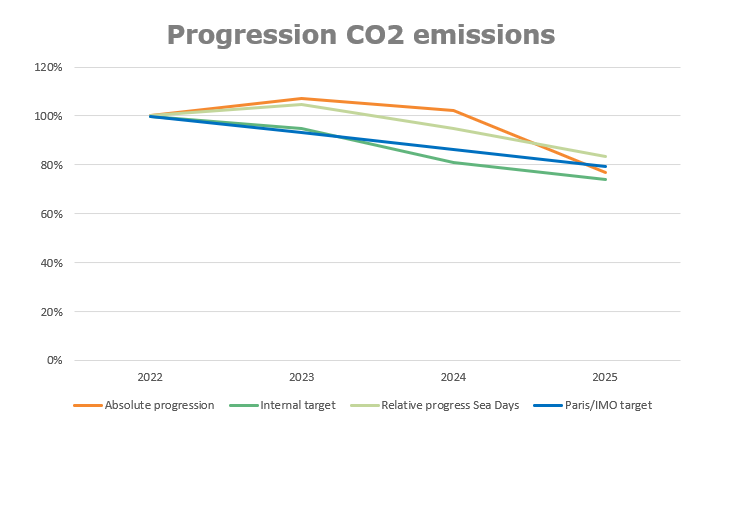
We began reporting our emissions in 2022, which now serves as our index year. At that time, the adoption of ChangeXL had already delivered a 9% CO₂ reduction, laying the groundwork for more ambitious targets.
In 2024, we achieved our first significant milestone: a 19% CO₂ reduction compared to 2022 emissions, driven by the fleet-wide implementation of HVO30. Building on this momentum, we have transitioned to HVO40 as of 1 January 2025, which reduced CO2 emissions by 23% by the end of the year. This brings us closer to our long-term ambition of a 82% reduction in emissions by 2031.
Bi-annual Highlights
Tracking the impact of our measures is essential to evaluating their effectiveness. Below is an overview of our CO2 emission reduction results compared to our targets. We provide a brief recap of our goals, followed by the realised reduction. For a more in depth analysis, please refer to our annual reports, available for download below.
These results will be published here soon.
By the end of 2025, Glomar Offshore achieved a fleet-wide CO₂ emission reduction of 19% compared to 2022. This improvement was primarily driven by the implementation of HVO40 across the fleet in the first half of the year, combined with a reduction in total seadays throughout the year.
Over the full year, our vessels consumed and emitted:
- 3.7 million litres Marine Diesel Oil – 12,767 tonnes CO₂
- 2.1 million litres HVO40 – 4,687 tonnes CO₂
- 0.2 million litres HVO100 – 77 tonnes CO₂
Our internal target for 2025 was set at 74% of 2022 emission levels (a 26% reduction). We reached 81% of 2022 levels. Despite falling slightly short of our goal, this still represents a substantial reduction in emissions and reflects continued progress in lowering our environmental impact across operations.
In August, Glomar successfully completed the roof reinforcement works. The installation of solar panels shall be supported by a large battery pack to store extra energy and is now expected to take place halfway through 2026. This measure should allow us to cover nearly all electricity consumption at the office with renewable solar energy.
To advance our mission towards a greener future, we implemented HVO40 across the fleet in January 2025. When HVO40 was unavailable in foreign ports, we compensated by bunkering HVO100 in Dutch ports, ensuring total emissions remained aligned with our reduction targets.
In the first half of 2025, our vessels consumed and emitted:
- 1.6 million litres HVO40 – 3,584 tonnes CO₂
- 1.2 million litres Marine Diesel Oil – 4,193 tonnes CO₂
- 0.2 million litres HVO100 – 77 tonnes CO₂
Our internal target for 2025 is set at 74% of 2022 emission levels (a 26% reduction). At the halfway point, we reached 72% of mid-2022 levels, putting us ahead of the pace needed to meet our full-year target.
In August, Glomar will carry out the necessary roof reinforcements to accommodate solar panels at our office. Given the scale of reinforcement required, installation is now expected around mid-2026 rather than within a month, and should enable us to achieve a 70% reduction in scope 2 emissions once operational.
By the end of 2024, the fleet-wide implementation of HVO30 resulted in a 2% increase in CO2 emissions compared to 2022, falling short of our revised target of a 19% reduction. This target was itself adjusted down from the original 28% after recognising that the baseline year (2022) already included the use of a ChangeXL blend, which had already reduced emissions by 9% compared to MGO.
Over the full year, our vessels consumed and emitted approximately:
- 8,214 tonnes CO₂ from Marine Diesel Oil
- 2,089 tonnes CO₂ from HVO30
- 399 tonnes CO₂ from HVO100
Our revised target for 2024 was set at 81% of 2022 emission levels (a 19% reduction), down from an original goal of 72% (a 28% reduction). We ended the year at 102% of 2022 levels. Given that 99% of our total emissions fall under Scope 1, this increase applies nearly in full to our overall emissions footprint. We did make progress in Scope 2 emissions, achieving a 34% reduction through the installation of LED lighting in the office and optimisation of the air conditioning system.
Scope 3 emissions have decreased by 8% compared to 2022, primarily due to a reduction in declared kilometres. However, as outlined in our annual report, flight-related emissions for both 2022 and 2023 have been adjusted due to insufficient records. For these years, we have applied the 2024 flight emission figures to ensure consistency and prevent inaccurate conclusions about an apparent increase in 2024.
Our goal was to implement HVO30 fleet-wide by January 2024 and achieve a 28% reduction in scope 1 and 2 CO2 emissions. Unfortunately, HVO-fuel is not always available in some ports. To compensate, we began occasionally bunkering HVO100, striving to achieve the equivalent of CO2 reduction from HVO30.
In the first half of 2024, our vessels consumed and emitted approximately:
- 6,358 tonnes CO₂ from Marine Diesel Oil
- 5,114 tonnes CO₂ from HVO30
Our target for 2024 was set at 72% of 2022 emission levels (a 28% reduction). Despite a 7% increase in CO2 emissions in mid-2023, at the halfway point of 2024 we were at 105% of mid-2022 levels — a 5% increase, putting us behind the pace needed to meet our target.
CO₂ emissions from company cars have decreased by 32% since 2022. Energy consumption at the office and emissions from business travel have remained relatively stable. From 2024 onwards, flight emissions are being tracked more accurately, supporting a more comprehensive and transparent reporting process. As a result, the 2024 flight emission figures have also been applied retrospectively to 2022 and 2023.

SDG Commitments
As an offshore charterer, we are committed to supporting a more sustainable future. Where possible, we align our activities with broader sustainability objectives and support responsible practices within the offshore chartering industry. Our operations play a key role in offshore wind and renewables, while continuous improvements are made to enhance efficiency and reduce environmental impact at sea.
We actively adopt energy-efficient solutions, including the increasing use of HVO. This drop-in fuel, produced entirely from certified waste or residue feedstocks, can reduce carbon emissions by up to 89% without requiring engine modifications. By bunkering HVO, sailing at ECO-speed where feasible, and optimising port calls, we minimise emissions and avoid unnecessary fuel consumption.
Sustainability is further embedded through operational and technical choices. The rebuilding of two vessels and the construction of a new vessel provide opportunities to integrate future-proof, sustainable innovations. Each vessel operates under a Garbage Management Plan, with crews trained to handle waste responsibly and reduce marine pollution. In parallel, we collaborate closely with industry partners and stakeholders to drive innovation, share knowledge, and strengthen sustainable practices across the offshore chartering sector.